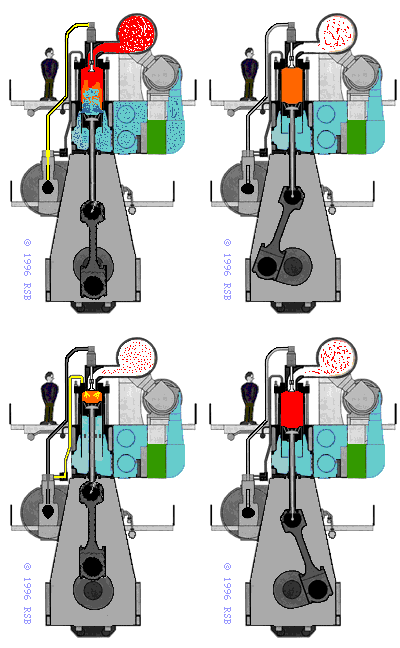
Heat engines are sometimes referred to as being motors. Actually, a motor converts one form of energy into useful work without the intentional production of heat, such as an electric motor. A device which burns fuel creating heat to perform work is a heat engine. Heat engines can be classified as external combustion, such as steam boiler, or internal combustion (IC). They can further be divided into the spark ignited (SI) engine or the compression ignited engine (CI). The particular heat engine we are interested about with this webpage, is the Compression Ignited heat engine. This style of engine has been most famously referred to as the Diesel engine, named after it’s inventor, Rudolph Diesel.
The compression ignited internal combustion engine has two main designs: the four stroke cycle, and the two stroke cycle engine. They are both very common throughout the world because of their high efficiency - compare with other types of heat engines. They burn a wide variety of hydrocarbon fuel, which is still common. Heavy fuel oil, intermediate fuel oil and marine diesel oil are the most common hydrocarbon fuel. The two stroke and four stroke titles refers to the mechanical action of the machinery, in particular the piston within the cylinder, to achieve the theoretical Carnot heat cycle, as define by the laws of thermodynamics.
Diesel engines are furthermore sub-divided into three categories: slow, medium and high speed. Slow speed are considered to be up to 300 rpm such as most big two stroke engines commonly found on ships. Medium speed engines dwell in the 300 - 900 rpm range. They are most common on smaller ships and power plants driving electrical generators and / or the propeller. High speed engines are the most common. Their high revolutions are ideal for driving vehicles such as busses and yachts. All Diesel trucks and vehicles on our roads use this class of Diesels, having an rpm over 900.
The four stroke ...
 |
| four stroke engine |
 decks.
That creates a problem for the size engine the ferry needs. The power plant needs to fit
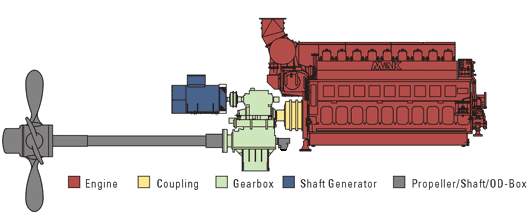
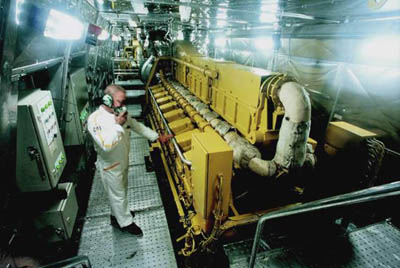
below the main deck and still be able to go in shallow waters. The engines installed in the Queen of Cowichan are
MAK 551 V12. They are a four stroke, turbo charged engine producing around
4,500 kW each. These engine stand less than twenty feet high and
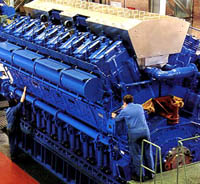
serve to illustrate the ideal application of a four stroke engine. A similar
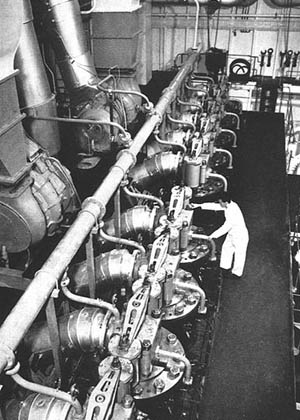
engine is pictured to the right.
decks.
That creates a problem for the size engine the ferry needs. The power plant needs to fit
below the main deck and still be able to go in shallow waters. The engines installed in the Queen of Cowichan are
MAK 551 V12. They are a four stroke, turbo charged engine producing around
4,500 kW each. These engine stand less than twenty feet high and
serve to illustrate the ideal application of a four stroke engine. A similar
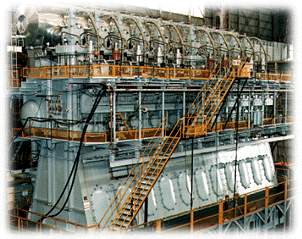
engine is pictured to the right.Four stroke engines are more complicated than the two stroke and "pack" less horsepower per pound. The two stroke actually produces more power, around 1.8:1. But the four stroke consumes less oil and can operate safely at high speeds. The four stroke Diesel engine is probably the most prevalent engine in all the world. They can be found producing power for
 oil
rigs in the North Atlantic or driving Volkswagen's New
Beetle DTI.
oil
rigs in the North Atlantic or driving Volkswagen's New
Beetle DTI.The Diesel engine uses a light distillate fuel oil, commonly known as Diesel. This of course, is more expensive than the Heavy Fuel Oil (HFO) which is burned more efficiently by the two stroke engines. Recent engine design development has provided bigger four stroke power plants with the ability to burn HFO. This development now makes the four stroke engine an attractive option to ship owners. The newest shipping market to employ four stroke engines are the cruise ships. They use four or five engines driving generators to produce electricity which is used to power the main driving (electric) motors and the "hotel load" (lights, heat etc.). With the cruise ship, we can observe the point made earlier, the need to keep the power plant "small", this is to make room for paying passengers.

The mechanics of it...
The four stroke is outwardly similar to it’s brother, the two stroke. But it’s inner working are quite different. One primary difference is the cylinder liner does not have the inlet ports machined into it. Another is the combustion air being drawn into the cylinder by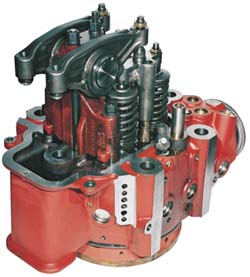 the piston.
This action is controlled by an inlet valve in the cylinder head, like the
one to the right. With no
need for a blower, this becomes the most radical difference between the four
and two strokes engines and as such, the four strokes are called naturally aspirated
engines.
the piston.
This action is controlled by an inlet valve in the cylinder head, like the
one to the right. With no
need for a blower, this becomes the most radical difference between the four
and two strokes engines and as such, the four strokes are called naturally aspirated
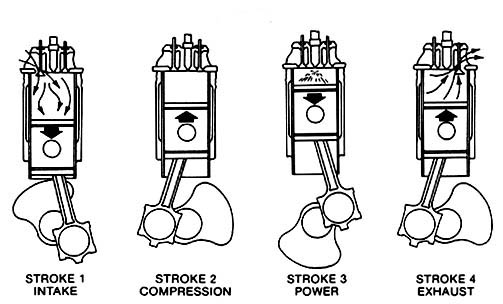
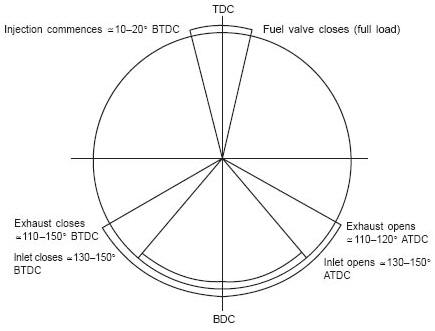
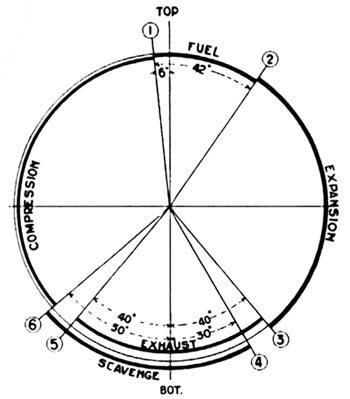
engines.The cycle comprises of: two crankshaft rotation and four change of direction by the piston. We will start with the inlet stroke at top dead center (TDC). See the diagram below for a visual representation.
At TDC the inlet valve is open allowing air to flow inside the cylinder. The downward action of the piston creates a vacuum which draws air into the cylinder. Shortly before the piston reaches bottom dead center (BDC), the inlet valve is closed. The piston at BDC begins it’s upward travel, beginning the compression stroke. The piston compresses the original air volume by about 17:1 to 23:1, to about 42 bars (~600 psi). The air’s volume reduction crushes the air molecule together and as result they build up heat.

1-2 suction, 2-3 compression, 3-4 injection (fuel)
4-5 expansion (power), 5-6 exhaust
 At 10 degrees before TDC injection of atomized fuel
begins, it burns, ignited by the high temperature from to the air being
compressed. Injection stops around about 35 degrees after TDC, depending on
the engine’s load. The fuel continues to burn and expands which increase
the cylinder temperature and pressure. Around 35 degrees after TDC injection
stops, and shortly after maximum pressure is reached within the cylinder,
this stage is commonly called Pmax. Pmax is anywhere between
180 bars to 195 bars (~2500 - 2800 psi); this is why Diesel engine
construction is so robust, it is to withstand this pressure.
At 10 degrees before TDC injection of atomized fuel
begins, it burns, ignited by the high temperature from to the air being
compressed. Injection stops around about 35 degrees after TDC, depending on
the engine’s load. The fuel continues to burn and expands which increase
the cylinder temperature and pressure. Around 35 degrees after TDC injection
stops, and shortly after maximum pressure is reached within the cylinder,
this stage is commonly called Pmax. Pmax is anywhere between
180 bars to 195 bars (~2500 - 2800 psi); this is why Diesel engine
construction is so robust, it is to withstand this pressure.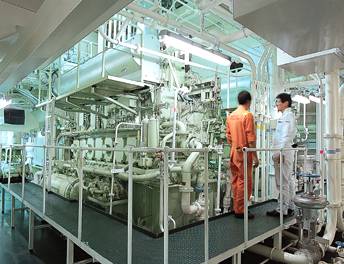


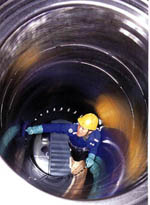 Slow speed, also allows a
direct coupling of the propeller shaft to the crankshaft,
eliminating the
need for gearing and such. The reduction of associated gear serves
to
increase their power to weight ratio which usually equates to lower
cost. Additionally, the two stroke engines have a less complicated
design, namely
no intake valves, this reduce the possibility of things failing.
These
attributes give the two stroke engine advantages over the four
strokes,
making it engine of choice for
Slow speed, also allows a
direct coupling of the propeller shaft to the crankshaft,
eliminating the
need for gearing and such. The reduction of associated gear serves
to
increase their power to weight ratio which usually equates to lower
cost. Additionally, the two stroke engines have a less complicated
design, namely
no intake valves, this reduce the possibility of things failing.
These
attributes give the two stroke engine advantages over the four
strokes,
making it engine of choice for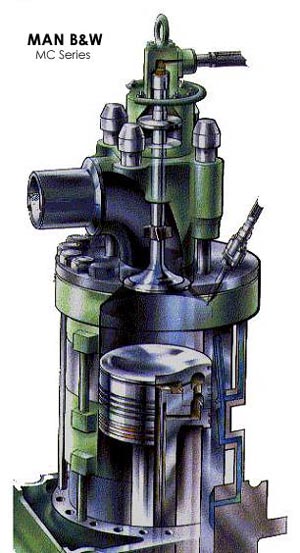 almost all
large deep sea ships.
almost all
large deep sea ships.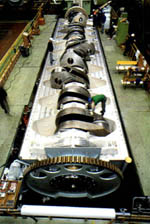 about 2/3 of the distance from the top
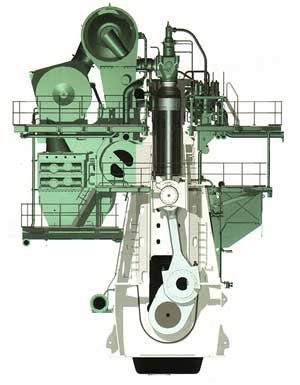
of the liner. The cylinder head, also know as cylinder cover, contain the
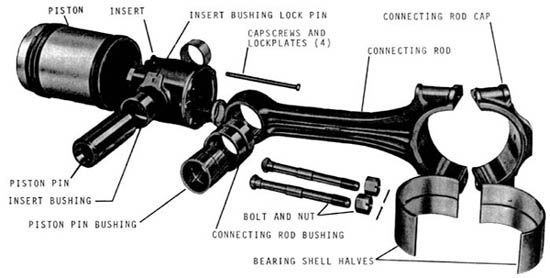
exhaust valve's) (pictured above). The piston within the cylinder is connected to
the crankshaft by the
connecting rod. On the larger
engines, the power is transmitted to a cross head assembly first. The cross
head slide up and down with the piston and transmit power from it to the
connecting rod and crankshaft.
about 2/3 of the distance from the top
of the liner. The cylinder head, also know as cylinder cover, contain the
exhaust valve's) (pictured above). The piston within the cylinder is connected to
the crankshaft by the
connecting rod. On the larger
engines, the power is transmitted to a cross head assembly first. The cross
head slide up and down with the piston and transmit power from it to the
connecting rod and crankshaft.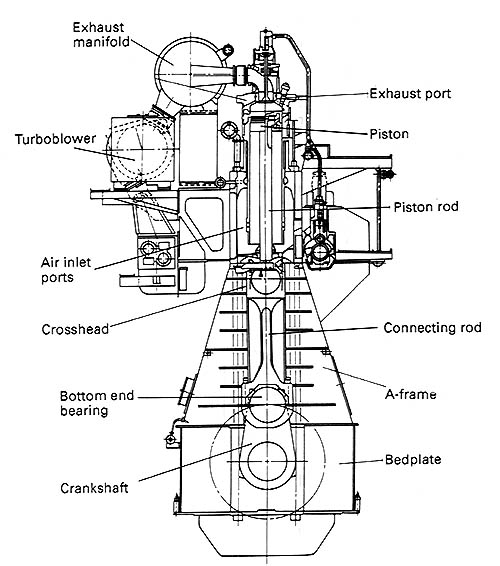
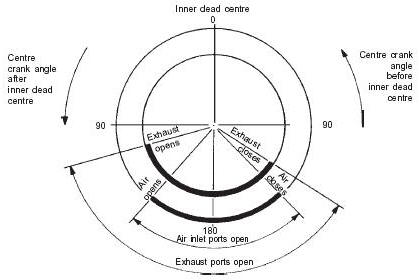
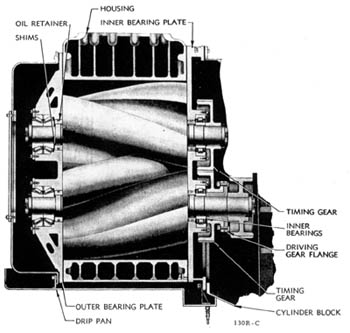 The continued downward travel of the piston
uncovers the inlet ports, where positively charged air, 30-70 kPa (3-4 psi),
provides a scavenging effect to drive exhaust gases out through the exhaust valve.
This action not only clears the cylinder of spent gases but also cools the
cylinder. Around 35 degrees after BDC the exhaust valve closes, and at 50 degrees
after BDC the inlet ports are covered (closed).
The continued downward travel of the piston
uncovers the inlet ports, where positively charged air, 30-70 kPa (3-4 psi),
provides a scavenging effect to drive exhaust gases out through the exhaust valve.
This action not only clears the cylinder of spent gases but also cools the
cylinder. Around 35 degrees after BDC the exhaust valve closes, and at 50 degrees
after BDC the inlet ports are covered (closed).